BIM

Towards Model Server
Chaos
In the past we had a pile of papers. Creative chaos of paper scrolls, which only got worse by the copying getting cheaper and more usual. Paper drawings were archived in shelves, cabins and special drawers.
Then came the computer files – all kind of files – especially DWG and DXF files. Files were here and there – everywhere. Every computer had different versions of different drawings. Floppies and diskettes were archived in shelves, safes and drawers.
Worst with the files was that they were incompatible. A file created with one software could not be opened with another program. Sometimes the program could not even open files created with an older version of the same software (and this may still be true).
Sometimes transferring data is partly successful. Part of the information is transferred correctly, part incorrectly and part possibly not at all. So the paper document was needed to compare which part of the information was transferred and which was not. Sound inconvenient – and that it was.
Standard
Products of Autodesk supported their own DXF standard for external connections. In practice DXF was similar to AutoCAD’s internal DWG standard, but sometimes contained less information and was one step behind DWG.
DXF was changed by new versions of AutoCAD, which made it hard for other software vendors to keep their product compatible. Simultaneously era of 2D drawing was passing, which made DXF obsolete.
IFC standard was developed to solve all these problems. IFC was born in international consensus for a need to create independent file format for presenting the whole information content of a building.
First versions of IFC were primitive, but promising. iFC standard was and still is further developed. International organizational work is slow and expensive and IFC is still not unquestionably supported by all software houses.
Chaos
Did the world change by the coming of IFC? Not much. The situation almost the same as with DXF ten years ago. Standard is changing. Different applications are different amounts and different ways compatible with the standard. Files are still transferred from one party to another – fast indeed via internet as email attachment or via project banks in more clever organizations.
In the worst and the most usual case different designers still have different versions of the design. Only difference to the past is that IFC is three dimensional and contains additional information of the building components.
Building industry is one of the rare industries where different parties or IT-wise so apart from each other.
Teamwork
Currently almost all applications support group work, which usually solves the need inside the organization, but seldom between the organizations.
There are two basic models to do group work. The more usual is to use common reference files. Reference drawings are linked into drawings and they can be viewed as part of the drawing. This model works and fits in to design processes where the task can be divided in this kind of a hierarchical way into independent parts. Possible problems are updating the reference files and planning a functional file hierarchy.
Another solution is teamwork promoted by ArchiCAD. In teamwork model several designers are working on a seemingly same drawing. Designer makes a partial reservation in the model and can freely work in his or her reserved content. This model is more flexible. The bottle neck in the way Graphisoft has solved this is the huge amount of transferred information, which makes it slow on big projects.
These two model can be also mixed and used simultaneously, which creates almost limitless possibilities in the ways of dividing the project for different designers and other parties.

Currently different parties of design process live in their own worlds and transfer information between the worlds in every direction.
In ideal situation different parties are in continuous connection with the common truth and live in the same universe.
Chaos
Even simultaneous interaction and designing in a team is possible in one organization, it is not running well in practice between different organizations. This is due to incompatible applications.
Practically one application, such as ArchiCAD, could be used for design simultaneously in different organizations. But ArchiCAD is primarily architect’s tool, so there are no suitable add-ons for HVAC and electric design. And even when there are add-ons, such as ones for structural design, it is unlikely that the selected engineer is using that certain add-on on top of ArchiCAD.
Partial workaround is to import designs from other applications into ArchiCAD as reference files or via teamwork functionalities, in the architectural office or other parties’ facilities.
Teamwork of ArchiCAD is suffering of slowness, which makes standard WAN absolutely too slow in big projects — especially if the model contains all information of parties designs.
1TnD1P
Life in Chaos will continue until IFC or some other information model standard fulfills the needs of information producers and common place for storing all produced information is found.
For this goal I have given name “1TnD1P”, which means one truth in n dimensions in one place. In M.A.D. Ltd we have used advertising slogan “One Truth”, which comes from this name, which is what ArchiCAD is fulfilling in itself.
Even no one is against this vison – or perhaps just because of that – I feel, that organizations, different parties, software vendors and designers have not interiorized it yet. We can all reach this ideal faster, if every morning we all utter in our minds “1TnD1P” and take small steps towards the same direction.
Thursday, 18 June 2009
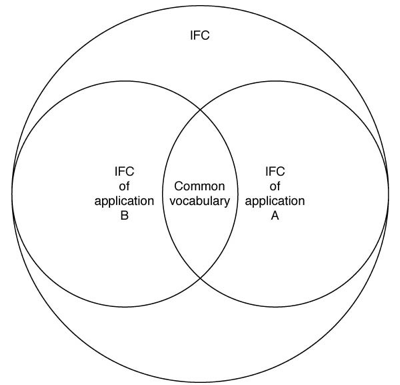
Maximum amount of transferred information between two applications is limited to their common vocabulary.
